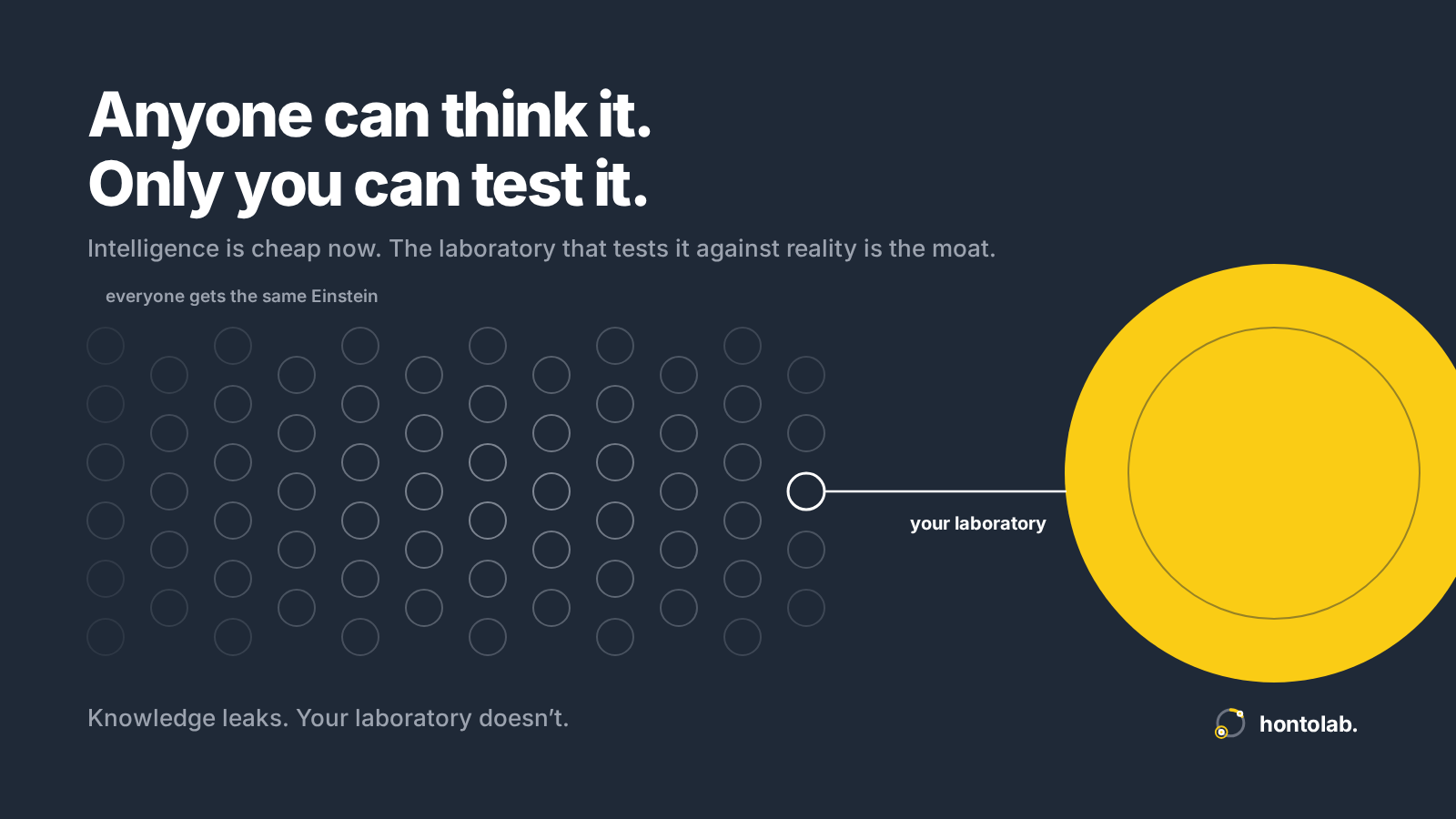
Everyone gets the Einsteins. Only you have the laboratory.
You have the best engineers. Or the best chemists. Or the one person who really understands the machine. Fine, let's say it's true. Now give everyone an Einstein for about twenty dollars a month, your competitor included. They get the same Einstein you do, out of the same box. Is your advantage still true? And if it isn't, how do you act?
The first sentence in the room #
This started as a conversation with a leader at a Swiss high-tech manufacturer, a world leader in its field. The first sentence in the room is always the same: we have to protect our data and our know-how. That's an understandable reaction, and part of it is simply the law.
But watch what the sentence does. Everything gets complicated. Every use needs a permission. AI ends up in a corner, tidying meeting notes and helping with a bit of software. And there's a clock on it: the technology moves faster than the meeting that decides what to do about it.
There's a name for what the room is managing: the information risk. What do we give away? There's no name for the other one, so nobody manages it: the intelligence risk. What do we fail to learn, every day, because we cut ourselves off from the best intelligence available?
Meanwhile the potential isn't a percentage, it's a multiple, and the competitor who takes the multiple is not going to wait for your process. In Europe, where industry has to move faster on every level just to stay in the game, that's not a comfortable thought.
Try the opposite #
Here's the exercise we did on ourselves. What happens if you embrace AI fully instead? Everyone, everything, every day.
The productivity is the boring part. The interesting part is the question it forces: what are you actually protecting?
Not your engineering. Not your maths, your chemistry, your statistics. That knowledge was the moat for a century, if it ever fully was, and it's hard to see it staying one. Anyone can rent it now, and they're renting the same one you are. Your experts don't become worthless. They become the people who can tell a good idea from a plausible one. Not scarce as knowledge. Essential as judgment.
What's left is the laboratory #
"It does not make any difference how beautiful your guess is. It does not make any difference how smart you are, who made the guess, or what his name is – if it disagrees with experiment it is wrong."
Richard Feynman, The Character of Physical Law, 1965
An Einstein can understand everything and still has to check the idea against reality. Your production line. Your customers. Your failures. Your measurements from last Tuesday. A hundred Einsteins in the building, and every one of them wants to see the machine.
Only you have the machine. That's the moat. Not what you know: what you can test against.
And it's easier to protect #
This is the part nobody expects. Start with the old moat, general knowledge. Can you even protect it? It leaks through every hire, every supplier lunch, every conference. And now it leaks through every employee with a private subscription, because whoever uses the Einstein gets a personal advantage, and they will. Ban it and the leak doesn't stop. It just stops being visible.
The new moat is a different kind of thing. The Einstein doesn't need your whole plant on its desk. It needs to check one idea against it. The data stays where it is; what moves is a question and an answer. That's small, concrete, in systems you already own, and useless to anyone who doesn't have the plant. Your production data doesn't go to conferences.
So the rule flips. Wide open on the intelligence, sealed on the laboratory. Most companies do it the other way round: walls between their own sites, and an open door to the outside.
The hard part isn't the decision. It's that the laboratory has to learn. A finding in someone's private chat is an anecdote, not a moat. Making it land somewhere shared, where the next Einstein starts from it, is what a shared handbook is for: one every agent reads and the company owns.
The fair objection: this sounds like sending everything everywhere. It isn't. The balance is one sentence: use the best intelligence available, keep the knowledge it produces under your own control, and stay able to act.
Make sure the laboratory learns, and that the learning stays yours.